

Understanding how your WA ATAR calculation works in Western Australia is essential for every student completing the Western Australian Certificate of Education (WACE). Whether you’re aiming for university entry or benchmarking your performance across subjects, knowing how your ATAR is formed helps you plan and track your results more effectively.
The ATAR – or Australian Tertiary Admission Rank – represents your overall academic standing compared with all other Year 12 school leavers in Western Australia. It is calculated from your scaled WACE course results and reported by the Tertiary Institutions Service Centre (TISC), using data supplied by the School Curriculum and Standards Authority (SCSA).
From 2028 onwards, the calculation method remains consistent with recent years, but with one clear simplification: there are no additional 10% bonuses for Mathematics Methods and Specialist or Languages Other Than English (LOTE). Your ATAR is derived purely from your best four scaled subject results.
What the ATAR Represents
Understanding the WA ATAR calculation Process
Your ATAR is not a mark or percentage; it is a rank position between 0 and 99.95 that indicates how your results compare with other students in the state.

For example, an ATAR of 75.00 means you performed as well as or better than 75 per cent of the Year 12 school-leaver population in Western Australia.
Because the ATAR system is standardised nationally, a WA student’s rank can be directly compared with those from other states when applying for university places.
WACE Marks vs the ATAR
One of the most common points of confusion is the difference between WACE marks and the ATAR. They measure very different things.
WACE Marks
- Show your achievement in each individual course.
- Are reported as percentages out of 100.
- Are aligned to SCSA performance standards.
- Can only be compared with other students who took the same subject.
- Are issued by SCSA.
ATAR
- Is a rank, not a mark.
- Represents your overall academic position relative to your peers.
- Allows fair comparison across different combinations of WACE subjects.
- Is issued by TISC and used by universities for admissions.
In short, WACE marks describe how well you did in each subject, while the ATAR describes how you ranked overall among all Year 12 students.
What “Scaling” Does (and why it matters)
To compare different courses fairly, TISC applies scaling to your results. Some subjects attract stronger cohorts; others have broader participation. Scaling adjusts course results onto a common scale so a 75 in one course represents the same level of achievement as a 75 in another for university selection.
At a high level:
- Moderation & standardisation (SCSA): your school assessments are moderated against the exam, combined with your exam mark, and standardised so courses sit on a common statewide scale.
- Average Marks Scaling (TISC): course results are adjusted using how students in each course perform across their other courses. Stronger-cohort courses tend to scale a little higher; others may scale a little lower.
- From 2028 onwards, your maximum TEA is 400 (4 x 100)
Importantly, scaling does not change your school report or WACE certificate. It only affects how scores contribute to your ATAR behind the scenes.
Understanding the TEA (Tertiary Entrance Aggregate)
Before you can find your ATAR, you need to know your Tertiary Entrance Aggregate (TEA).

Your TEA is the sum of your best four scaled subject scores from your WACE ATAR courses.
Each course’s scaled score is calculated from:
- 50 % your school assessment (moderated to state standards).
- 50 % your WACE exam performance.
TISC then scales all subjects to ensure fairness across courses. This means harder subjects are adjusted so that no student is disadvantaged or advantaged simply by subject choice.
Example 1 (2028 onwards – no bonus subjects used)
| Subject | Scaled Score | Used in TEA? |
| English | 85 | Yes |
| Chemistry | 78 | Yes |
| Human Biology | 81 | Yes |
| Mathematics Methods | 74 | Yes |
| Modern History | 70 | No |
Total TEA = 318
TISC then converts your TEA into an ATAR using statewide scaling tables ⇒ ATAR ≈ 97.45
Example 2 (2027 – bonus subjects still applied)
| Subject | Scaled Score | Bonus | Used in TEA? |
| English | 85 | 0 | Yes |
| Chemistry | 78 | 0 | Yes |
| Human Biology | 81 | 0 | Yes |
| Mathematics Methods | 74 | 7.4 | Yes |
| Modern History | 70 | 0 | No |
Total TEA = 325.4 ⇒ ATAR ≈ 98
Exact ATAR values vary slightly each year depending on cohort performance.
How the Conversion Works
TISC uses the statewide distribution of students’ TEA scores each year to determine ATAR rankings. The highest aggregated TEA scores are assigned an ATAR close to 99.95, and the scale adjusts downward based on how all eligible students perform that year.
This means the exact relationship between TEA and ATAR varies slightly each year – it is not a fixed published table. ATAR is always a rank, not a percentage or mark.
The calculation considers:
- The total number of eligible WACE students.
- Their relative TEA scores.
- How those scores distribute across the state population.
Understanding the bonus phase-out timeline?
- Up to and including the 2027 cohort: a 10% bonus could be added for Mathematics Methods, Mathematics Specialist, and one LOTE course. These bonuses applied whether or not the course sat in your best four.
- From 2028 onwards: no bonuses apply. Everyone’s maximum TEA is 400, calculated purely from your best four scaled scores. The underlying moderation, standardisation and scaling processes remain the same – only the extra 10% add-ons have been removed for simplicity and national consistency.
What does this mean for you?
If you’re graduating in 2028 or later, plan subjects for fit, prerequisites, and where you can score highly. Strong performances in traditionally demanding subjects can still yield high scaled scores – there’s just no extra 10% on top.
Quick truths about scaling (myths, busted)

“Pick only subjects that scale up.”
Not necessary. You benefit most where you perform best. A strong result in a “lower-scaling” subject can outscore a middling result in a “higher-scaling” one once your best four are chosen.
“Scaling is unfair.”
Scaling exists to remove unfairness between subjects with different cohorts and difficulty profiles. It doesn’t “punish” or “reward” you arbitrarily – it levels comparisons
“There’s a fixed scaling table.”
No fixed, public table. Each year’s mapping from TEA to ATAR depends on the cohort’s distribution.
Smart subject planning (fast, practical tips)
- Play to your strengths: choose subjects you enjoy and can sustain high performance in.
- Check prerequisites: some uni pathways expect Methods/Specialist, Chemistry, Physics, or a Language. These still matter even without bonuses.
- Balance your load: mix “challenge” subjects with ones you’re confident in to protect your best four.
- Focus on consistency: one weak outlier often drops out of your TEA – but lifting mid-range subjects by a few scaled points can shift your overall rank meaningfully.
- Use real data and feedback: practice exams, school feedback, and analytics tools help you target where a few extra marks improve your TEA the most.
How ReviseOnline CALCED Helps You Optimise Your ATAR
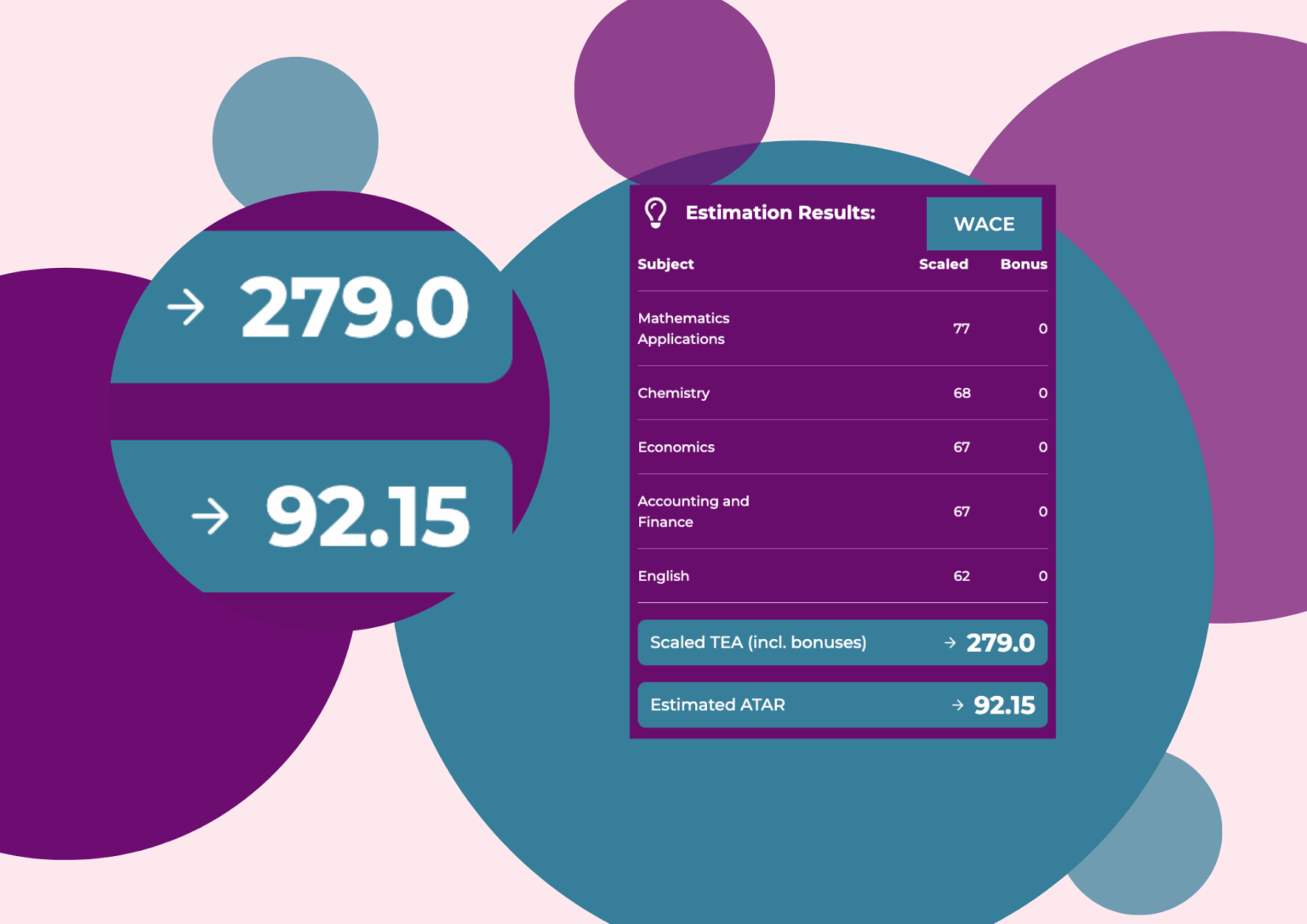
Understanding the numbers is one thing; improving them is another. ReviseOnline’s CALCED analytics platform helps students interpret and track the same metrics that underpin the WA ATAR calculation.
Within CALCED, you can:
- Monitor performance trends across all WACE subjects.
- Benchmark your scaled results against peers from more than 100 schools.
- Identify where extra marks could boost your TEA and overall ATAR.
- Use interactive graphs to explore how improving one subject affects your predicted rank.
This data-driven insight turns the ATAR calculation from a mystery into a clear performance map – helping you study strategically and focus where improvement delivers the biggest gain.
Key Takeaways
The 2028 TEA includes no bonuses for Maths Spec & Methods or Languages Other Than English.
Your best four scaled scores only count (maximum 400).
WACE marks and ATAR serve different purposes – marks show achievement; the ATAR shows rank.
Scaling ensures fair comparison between subjects.
Understanding your TEA is the first step to targeted improvement.
ReviseOnline CALCED provides the analytics to turn that understanding into action.