

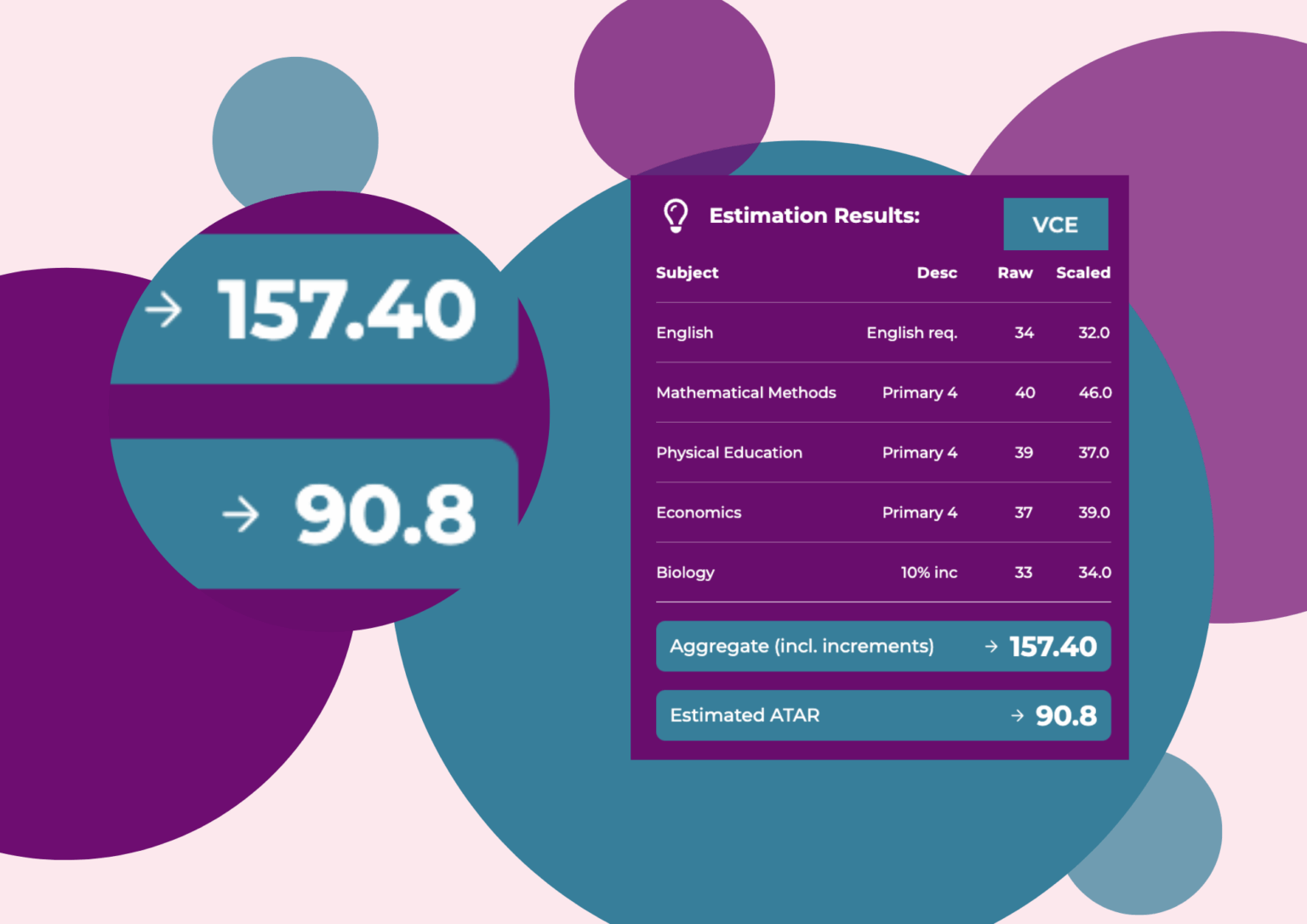
Understanding how the VCE ATAR calculation works is essential for any Victorian Certificate of Education (VCE) student planning their pathway to university. The Australian Tertiary Admission Rank (ATAR) is the key figure used by tertiary institutions across Australia to compare the performance of Year 12 students, regardless of which state or subjects they studied.
In Victoria, your ATAR is determined through a process managed jointly by the Victorian Curriculum and Assessment Authority (VCAA) and the Victorian Tertiary Admissions Centre (VTAC). The VCAA conducts and assesses all VCE subjects, while VTAC scales the results and converts them into the national ATAR ranking.
What is an ATAR Score?
An ATAR score is a percentile rank – not a percentage mark. It shows how your overall academic achievement compares with every other Year 12 student in Australia.
An ATAR of 75.00 means you performed better than 75 per cent of the total Year 12 cohort in your state. The highest possible ATAR is 99.95, representing the top 0.05 per cent of students.
Because it is a ranking system, the ATAR is not a direct measure of raw marks but a comparative indicator of performance across subjects and students nationwide.
Who Calculates the ATAR in Victoria?
In Victoria, VTAC is responsible for calculating your ATAR, using data supplied by VCAA.
VCAA awards each student a raw study score for every subject completed as part of the VCE. These scores are then provided to VTAC, which performs scaling to ensure fairness between subjects with differing levels of competition or difficulty.

To receive an ATAR, students must complete at least four approved VCE studies, including at least one English-based subject.
How Raw Study Scores Work
Each VCE subject you take receives a raw study score between 0 and 50. This score reflects how well you performed compared with other students who studied the same subject that year.
A score of 30 represents the average performance, while a score above 40 places you among the top 9 per cent of students in that subject. These scores are based on your school-assessed coursework and VCAA examination results, with scaling applied later by VTAC.
How Scaling Works (VTAC Process)
Not all VCE subjects have the same degree of competition. Some subjects attract students who perform very strongly overall (for example, Specialist Mathematics or Physics), while others may attract a broader performance range.

VTAC’s scaling process ensures that no student is advantaged or disadvantaged by subject choice. This is achieved by adjusting each subject’s raw study scores according to the strength of its cohort.
Key principles of scaling
- If many students in a subject perform highly across all their studies, that subject will typically scale up.
- If students in a subject perform slightly lower on average in their other studies, that subject may scale down.
- Scaling only affects your ATAR calculation, not the results printed on your VCE certificate.
- This scaling adjustment makes comparisons between different subjects fair and consistent across the state.
Step-by-Step: How the ATAR Is Calculated
The ATAR is derived from an aggregate, which is the sum of your scaled study scores. VTAC calculates this aggregate using up to six scaled study scores:
- Your best English score — from one of English, English Language, English as an Additional Language (EAL), or Literature.
- Your next three highest scaled scores from other VCE subjects.
- 10 % of the fifth and sixth scaled study scores (if you completed more than four subjects).
This total becomes your aggregate score, which VTAC then converts into a percentile ranking – the ATAR.
For instance, an aggregate around 150 might correspond to an ATAR of approximately 70, while an aggregate near 210 may result in an ATAR close to 90. These values shift slightly each year depending on the performance distribution across the state.
ATAR Range and Interpretation
The ATAR ranges from 0.00 to 99.95, reported in increments of 0.05. The lowest rank automatically issued is 30.00, while results below that threshold are reported as “less than 30”.
This ranking system allows universities to compare all Year 12 students equitably, regardless of subject choice or school.
For example:
- An ATAR of 60.00 means you performed better than 60 per cent of students.
- An ATAR of 90.00 places you in the top 10 per cent statewide.
Because each year’s scaling and distribution differ, direct comparisons between cohorts (e.g. 2025 vs 2026) are not exact — only rankings within the same year are equivalent.
For complete and current details, refer directly to: