

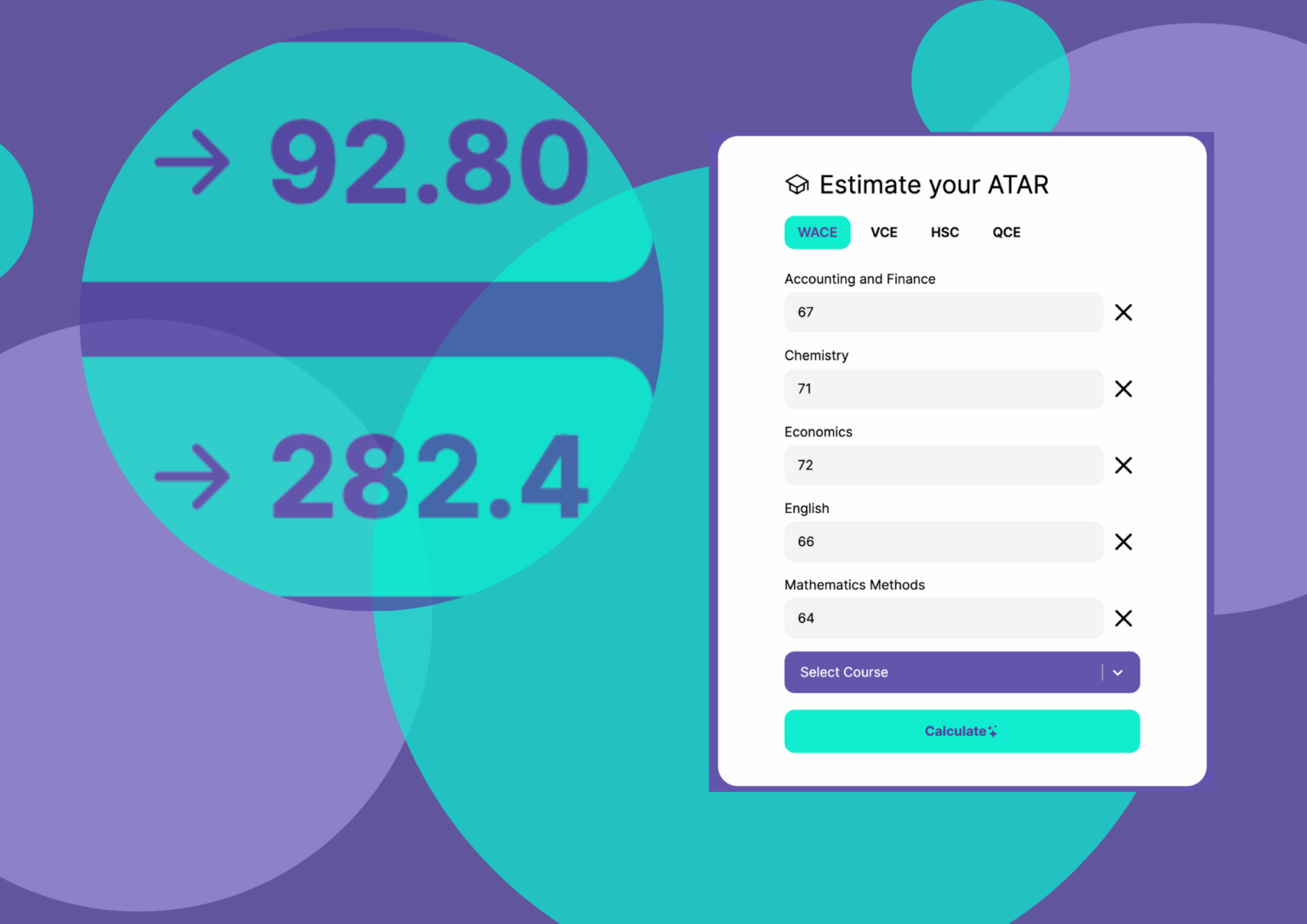
Confused about how your ATAR is calculated? You’re not alone. In this blog post, you’ll find a clear, simple explanation of how ATAR is calculated. We’ll crack the ATAR code by breaking down how your Year 12 school and exam marks turn into an ATAR, including key steps like moderation, standardisation, and scaling. This Australia-wide guide covers the essentials common to all states (with a few notes on regional differences, like NSW’s NESA/UAC and WA’s SCSA/TISC). By the end, you’ll understand what an ATAR really means (hint: it’s a rank, not a score) and clear up common misconceptions. Let’s dive in!
What is the ATAR?
The Australian Tertiary Admission Rank (ATAR) is the number used for university entry in Australia, but it’s not a score out of 100; it’s a rank. In other words, the ATAR indicates your position relative to all other students in your age cohort. An ATAR ranges from 0.00 up to a maximum of 99.95, reflecting a percentile ranking. For example, an ATAR of 80 doesn’t mean you scored 80%, it means you performed as well as or better than 80% of your Year 12 age group. It takes into account everyone of Year 12 leaving age (including those who didn’t finish Year 12), which is why the median ATAR is often significantly above 50 (in NSW it was about 71.75 in 2024).
While each state or territory has its own education authorities and admissions centre, the ATAR itself is a nationally equivalent ranking. For instance, in New South Wales, HSC results are released by NESA, and UAC then calculates the ATAR, whereas in Victoria, VCE results from VCAA go to VTAC for ATAR calculation. Despite minor differences, an ATAR of X in one state equals the same ATAR in every other state. This common scale allows universities to fairly compare students Australia-wide. In short, your ATAR is a ranking system used to allocate university placements, not a direct summary of your exam marks. Try our ATAR Calculator to see your results.

“Your ATAR isn’t a score out of 100 — it’s a rank that shows how you performed compared to everyone else in your year.”
How Are ATAR Scores Calculated?
Understanding how ATAR is calculated can demystify the process. Here’s a step-by-step breakdown that applies across Australia (with slight variations by state):
- School Assessments and Final Exams
Throughout Year 12, students complete school-based assessment tasks (assignments, tests, projects, etc.) for each subject. At year’s end, they sit external final exams for those subjects. For example, in the HSC (NSW), your final HSC mark for each course is a 50/50 blend of your school assessment mark and exam mark. The exam marks are set and graded by the state exam authority (like NESA in NSW or VCAA in Victoria). These raw results will later be used to derive the ATAR. - Moderation of School Marks
To ensure fairness across different schools, the internal assessment marks are moderated against exam performance. Essentially, each state’s exam authority adjusts the school-based marks by comparing them with how students from that school performed on the external exam. This process keeps student rankings within a school but scales the scores so that a mark from one school is comparable to the same mark at another school. Moderation guarantees that a student isn’t unfairly advantaged or disadvantaged by their school’s grading standards. - Standardisation (Alignment of Exam Marks)
After exams are marked, many boards align or standardise the raw exam scores to a common scale or set of performance standards. For instance, in NSW, raw HSC exam marks are aligned to predefined performance bands (Band 6, Band 5, etc.) so that the mark reflects what a student knows and can do relative to set standards. This standardisation ensures consistency year to year. (Note: the reported marks you see on your certificate are usually these aligned marks, not the raw exam score.) - Scaling of Subject Marks
Here’s where the ATAR scaling explained part comes in. Each tertiary admissions centre (UAC, VTAC, QTAC, etc.) takes the moderated school marks and exam marks (generally before alignment to bands) and scales them for each subject. Scaling adjusts for differences in difficulty and competition between subjects. The principle is that you should be neither advantaged nor disadvantaged by choosing specific subjects. If one course’s students are generally very high-achieving, that subject’s raw scores might be scaled up (because getting, say, 80 in a very competitive subject might reflect a stronger performance than 80 in a less competitive subject). Conversely, an “easier” subject with more modest overall achievement might lower scale scores. Scaling is essentially like converting marks to a common currency so they can be compared fairly. Importantly, scaling does not mean you lose marks arbitrarily; it’s about comparing relative performance. Even in high-scaling subjects, you still need to perform well in that subject to get a high scaled mark. And for most subjects, your scaled mark will be a bit lower than your raw exam mark (since only the top students in each course receive the highest scaled scores). - Calculating the Aggregate (Total Score)
Once all subjects are scaled, the admissions centre picks your best subjects to form an aggregate score, sometimes called an ATAR aggregate or Tertiary Entrance Aggregate (TEA). Usually, there are rules about how many subjects count, typically your best 4 or 5 subjects count fully, and a 5th or 6th subject can contribute partially. For example, in Victoria, your aggregate is the sum of your scaled scores in English plus your next best 3 subjects, plus 10% of your fifth and sixth subject scores. In NSW, the aggregate is based on your best 10 units (where 2 units of English must be included) out of 500 points total. In Western Australia, at least four subjects are required; they sum the best four scaled scores (this is the TEA in WA), which is then used to derive the ATAR. No matter the state, the idea is the same: you get a total from your top performances across a range of subjects (ensuring some breadth, like including English). This aggregate is the number that will be ranked. - Ranking and ATAR Percentiles
Finally, all students’ aggregates are ranked from highest to lowest and converted to percentile rankings. The highest-scoring students are assigned the top percentile (99.95). From there, each successive percentile (99.90, 99.85, and so on) is assigned to the next group of students. Your ATAR is basically the percentile rank corresponding to your position in this list. For example, if your aggregate is ranked in the top 15% of the age cohort, you’ll get roughly an ATAR of 85.00. This ranking process is why ATAR is a rank, not a raw score; it shows how you performed relative to others. Important: The ATAR is truncated at 99.95 as the maximum; you’ll never see a 100.00 ATAR, because even the top student can’t outrank themselves. Similarly, very low ranks are usually just reported as “below 30” rather than a specific number.

“Scaling doesn’t reward or punish you — it exists to keep subject results fair and comparable.”
What Your ATAR Really Means
Your ATAR result comes with a lot of anxiety and myths, so let’s clarify how to understand your ATAR in Australia:
- It’s a Rank, Not a Mark: The ATAR is not a score out of 100; it’s your rank position among all Year 12 students.
- It’s Not an Average of Your Marks: The ATAR is derived from scaled marks, not your raw subject scores.
- Scaling isn’t a Penalty or Bonus: Scaling ensures fairness, not reward or punishment for subject choice.
- Percentile Perspective: ATAR ranks show relative performance, not absolute marks.
- National Consistency: An ATAR of 80 in NSW equals an 80 in WA or Victoria.
Common Myths and FAQs

“My ATAR = my exam scores average.” Myth! ATAR is derived from scaled marks, not a direct average.
“Taking easy subjects will boost my ATAR.” Myth! Scaling ensures no subject is inherently advantaged.
“ATAR measures my intelligence.” Myth! It’s simply a rank used for university selection.
Final Thoughts and Next Steps
Cracking the ATAR code boils down to this: your ATAR is a rank derived from a systematic process of moderation, scaling, and comparison of Year 12 results nationwide. By understanding this process, you can focus on doing your best rather than worrying about myths. Check out AssessED for tools to track your progress and identify areas to improve.
Ultimately, your ATAR is one pathway to university. Study hard, seek help when needed, and keep things in perspective. Good luck with your Year 12 journey, and remember, no single number can define your potential!