

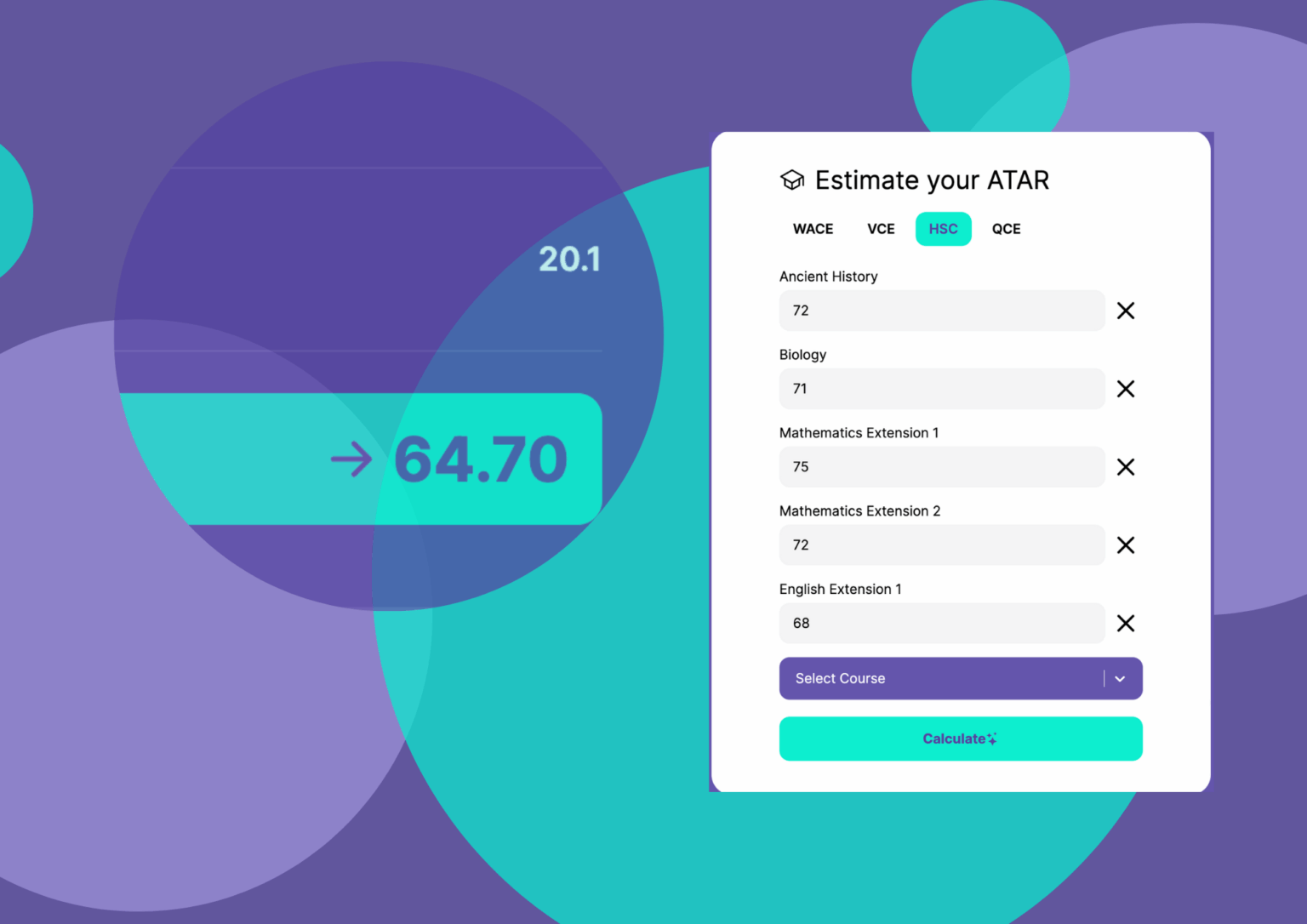
For students in New South Wales, the Higher School Certificate (HSC) is the culmination of years of schooling. Yet while the HSC gives you marks for each subject, what universities look at is the Australian Tertiary Admission Rank (ATAR). The ATAR can seem confusing because it’s not a percentage, and it doesn’t correspond directly to your HSC marks. Instead, it’s a ranking system that places you within your age group, using a complex process of scaling and aggregation. This article explains in detail how to calculate your ATAR in NSW, why scaling exists, and what you can do to maximise your outcome.
What Is the ATAR?
The ATAR is a number between 0.00 and 99.95, reported in increments of 0.05. It represents your overall academic ranking compared to all other students of your age in NSW, whether or not they actually sat the HSC. An ATAR of 80.00 means you have performed better than roughly 80 per cent of your age cohort. It’s important to understand that the ATAR is a rank, not a mark. This distinction matters because you could achieve an HSC mark of 80 in a subject but end up with an ATAR that is higher or lower than 80, depending on the scaling and the performance of other students.
Universities use the ATAR to compare applicants fairly. Thousands of students complete different subject combinations each year, and the ATAR provides a standardised way to measure overall achievement. However, the ATAR isn’t the only factor in university admission. Some courses consider interviews, auditions, portfolios or adjustment factors. Still, the ATAR remains the most widely used tool in determining eligibility for university places.
HSC Marks vs ATAR
One of the biggest points of confusion for students is the difference between HSC marks and the ATAR. Your HSC marks show how well you performed in each subject against a set standard. They are reported out of 100 for 2-unit courses and aligned to performance bands (Band 1 to Band 6). These marks reflect your achievement in a subject, not how you compare to students in other subjects.
Your ATAR, on the other hand, is about ranking. It combines your scaled marks from different subjects into a single score that places you relative to the entire cohort. This means that two students with identical HSC marks in different subject mixes may end up with very different ATARs. The key reason is scaling, which ensures fairness when comparing results across a wide range of courses.
How to Calculate your ATAR in NSW
Although the formula is detailed and statistical, the process can be broken into six main stages.
- Collect HSC Marks – Your final HSC mark for each course is the average of your school assessment and your exam result, both aligned to performance bands.
- Establish Relative Position – Your performance is compared with others in the same subject, producing a percentile that shows where you sit within that course.
- Apply Scaling – Marks are adjusted so that results from all subjects can be fairly compared. This prevents advantages or disadvantages arising from subject choice alone.
- Select Best Units – The ATAR calculation uses your best 10 units, which must include at least 2 units of English. The other 8 units come from your strongest scaled results.
- Aggregate Scaled Marks – Your best 10 units are added together to form an aggregate score, which represents your total scaled achievement.
- Determine ATAR – Your aggregate is compared to every other student’s aggregate in NSW, and you are assigned a percentile rank. This is then reported as your ATAR, rounded down to the nearest 0.05.
Why Scaling Exists
Scaling is one of the most misunderstood parts of the ATAR. It doesn’t reward or punish you for subject choice. Instead, it makes results comparable by adjusting for the strength of the student group in each subject. For example, advanced mathematics is usually taken by students who also perform well in other subjects. If raw marks were used without scaling, their overall results would appear artificially high compared to students in other courses. Scaling corrects this imbalance by ensuring that if the same group of students sat every course, the mark distribution would be consistent across all subjects.
It’s important not to choose subjects based only on perceived scaling advantages. Excelling in a subject you enjoy will generally produce a stronger ATAR contribution than struggling in a subject that traditionally scales higher. Scaling reflects patterns of candidature, not the inherent difficulty of the subject.
Common Myths About the ATAR

“The ATAR is just my average mark.” – False. It’s a rank based on scaled performance, not a raw percentage.
“Some subjects are always scaled up and others always scaled down.” – Not true. Scaling is recalculated each year, depending on the cohort.
“English doesn’t matter.” – Incorrect. English is compulsory and at least two units must always be included.
“The school I attend changes my ATAR.” – Wrong. The calculation only uses marks provided by NESA, not school identity.
Practical Strategies to Maximise Your ATAR
Knowing how the ATAR is calculated allows you to make informed decisions throughout Years 11 and 12. Here are strategies that can help you perform to your potential:
- Choose subjects you enjoy and can sustain effort in. Motivation is critical for two years of consistent study.
- Prioritise English, since it is compulsory and always included in the ATAR calculation.
- Spread effort evenly. Both school assessments and final exams count, so keep performance consistent across the year.
- Use practice exams and past papers under timed conditions to build familiarity with exam structures and improve time management.
- Seek targeted feedback from teachers, tutors, or study groups to identify weak areas early.
- Develop effective study habits, such as active recall, spaced repetition, and structured note summaries, rather than relying on last-minute cramming.
- Balance workload with rest and wellbeing. Sustained performance comes from consistency, not exhaustion.
Frequently Asked Questions
- Why doesn’t my ATAR match my marks? – Because your ATAR is a rank, not a percentage. Even strong marks may lead to a lower ATAR if many students performed at a similar level.
- Do low-scaling subjects hurt my ATAR? – Not if you perform strongly. Scaling ensures fairness, so excelling in any subject can contribute well.
- Why can’t I see my scaled marks? – They are not released to students. Only the final HSC marks and your ATAR are reported.
- Can extension courses count? – Yes, provided you complete the corresponding base course (with some exceptions in mathematics).
- Is the ATAR the only way into university? – No. Universities may also use adjustment factors, portfolios, auditions, or alternative pathways.
ATAR and University Selection
While the ATAR is central to admissions, it is not the sole factor. Universities also apply adjustment factors, sometimes called bonus points, for a range of reasons. These might include achieving high results in specific subjects, living in a regional area, or qualifying for equity schemes. Additional entry criteria can also apply to certain courses, such as interviews, auditions or the submission of a portfolio.
This means that two students with the same ATAR may have different overall selection ranks for the same course, depending on the adjustments applied. It is therefore useful to think of your ATAR as the baseline number, with universities sometimes shifting the ranking through additional considerations.
Key Takeaways
The ATAR is a ranking system, not a raw mark.
Scaling exists to ensure fairness across subjects with different candidature profiles.
Your best 10 units count, and English is compulsory.
Consistent study habits, subject choice based on strengths, and exam preparation strategies all contribute to maximising your ATAR.
The ATAR is important, but universities may also consider other factors such as adjustment points and additional entry requirements.